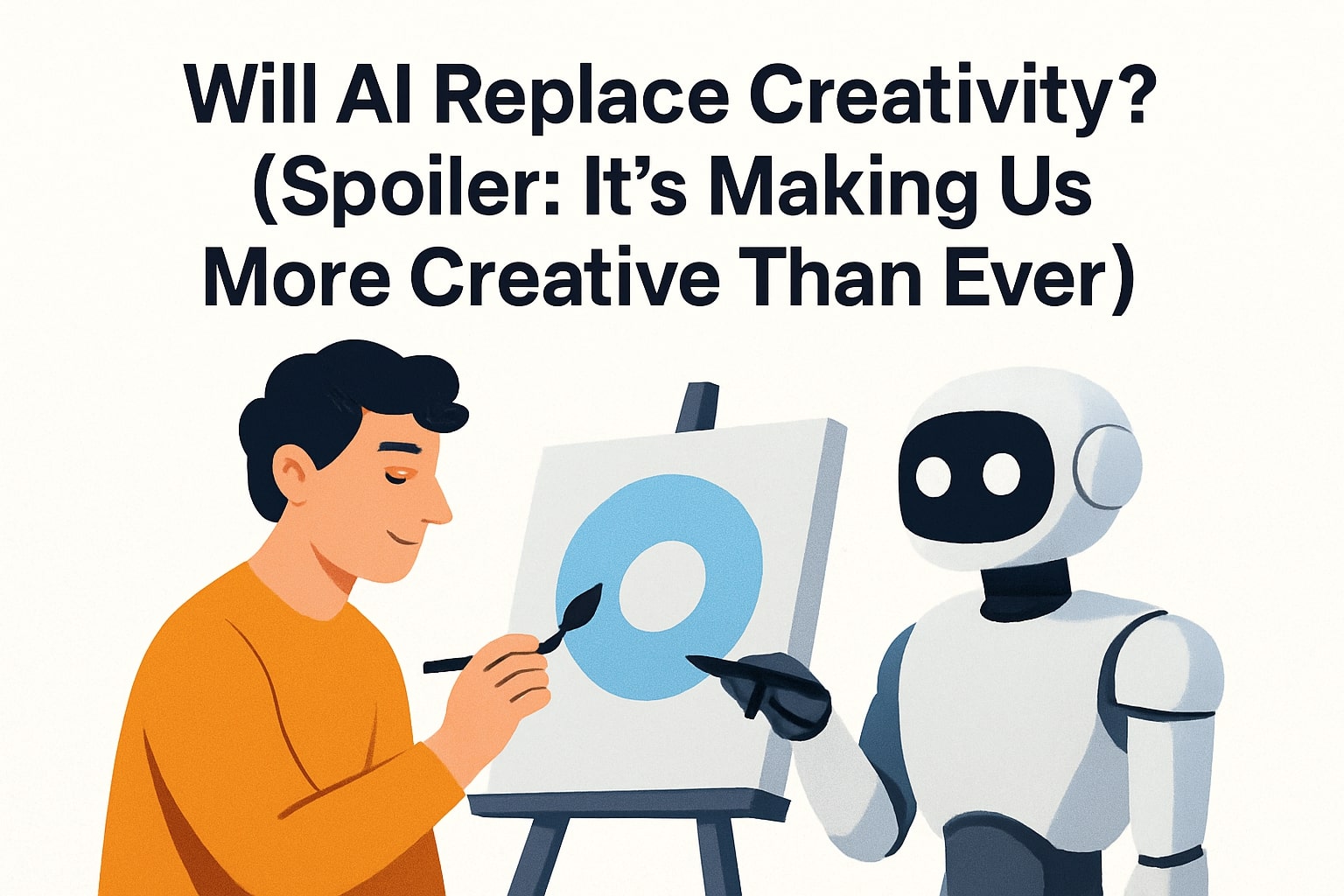
(Spoiler: It’s Making Us More Creative Than Ever)
Introduction: The Fear That Started It All
Every time a new technology emerges, there’s a familiar pattern: excitement, curiosity, and then — fear.
We’ve seen it before with photography (“Will this kill painting?”), with computers (“Will they take all our jobs?”), and now with AI, the question everyone’s asking:
“Will AI replace human creativity?”
It’s a fair question. AI can now write poems, generate lifelike art, compose music, and even design websites. Open tools like ChatGPT, Midjourney, Runway, and Claude can create in minutes what used to take humans hours — sometimes even seconds.
But here’s the truth most people miss:
AI isn’t replacing creativity, it’s redefining it.
We’re not watching creativity die; we’re watching it expand.
The Myth: “AI Is Taking Over Creativity”
Let’s start with the misconception that started this panic.
When people see AI generating art or writing articles, they assume creativity has been “automated.”
But creativity isn’t just about producing things — it’s about vision, taste, judgment, and connection.
AI doesn’t “feel.” It doesn’t dream or get inspired.
It doesn’t look at a blank canvas and think, what if I tried something no one has ever seen before?
What AI does is execute, and it does that exceptionally well.
But it still relies on us, humans, for direction.
So while AI can draw, paint, or compose, it’s doing so within the parameters we set.
It’s not replacing the artist; it’s amplifying the artist’s possibilities.
The Reality: Creativity Has Always Evolved With Tools
Every generation has had its “AI moment” — a time when new tools made people question what creativity even means.
- When the camera was invented, painters were terrified.
- When digital art came along, illustrators resisted it.
- When auto-tune appeared, musicians called it “cheating.”
Yet, in every case, something magical happened, instead of killing creativity, technology expanded it.
AI is just the newest chapter in that story.
It’s not the end of originality, it’s the beginning of frictionless creation.
Think of it like this:
AI doesn’t remove creativity. It removes the barriers between your ideas and your ability to bring them to life.
That’s what makes this era so exciting.
So What Does AI Really Do for Creativity?
1. It Speeds Up the Boring Stuff
Every creative process has two parts:
- The inspired part — where ideas flow.
- The tedious part — formatting, editing, rephrasing, refining.
AI helps clear that second half.
Writers use Claude or ChatGPT to structure drafts faster.
Designers use Canva’s Magic Studio or Gamma to instantly turn rough ideas into polished presentations.
Video creators use Runway to edit footage and remove backgrounds without hours of manual work.
The creative spark still comes from the human, AI just removes the friction
2. It Expands What’s Possible
AI is a creative multiplier.
A solo creator can now do the work of an entire production team:
- Write a script with ChatGPT,
- Generate visuals with Midjourney,
- Animate scenes using Runway,
- Add a voiceover using ElevenLabs,
- And publish in hours instead of weeks.
That’s not replacing creativity, that’s democratizing it.
Now, anyone with an idea can make something extraordinary.
The limits aren’t about money or access anymore, they’re about imagination.
3. It Sparks New Ideas
Here’s the thing most people miss, AI isn’t just about creating faster; it’s about creating differently.
When you prompt an AI image model or ask ChatGPT to brainstorm storylines, you’re not delegating creativity, you’re collaborating with something that thinks differently from you.
Sometimes, it surprises you.
It gives you combinations you’d never have thought of, a new color palette, a story twist, or a sound texture that feels fresh.
AI becomes your idea partner, not your competitor.
The New Definition of Creativity
Traditionally, creativity was defined by making something from nothing.
But in the age of AI, creativity is shifting toward curation, direction, and synthesis.
It’s about knowing what to make, not just how to make it.
It’s about asking better questions, not just giving better answers.
In short:
AI doesn’t make you less creative. It challenges you to be creative in new ways.
That’s the evolution.
Humans + AI: The Creative Partnership
Let’s think of AI as an extension of human imagination, like a digital collaborator who never gets tired.
You still need taste, instinct, and emotion to guide it.
The best results come not from asking AI to “do it all,” but from knowing what to ask and how to refine its outputs.
This is where human creativity shines, in judgment and interpretation.
An AI can generate a hundred logo ideas, but you decide which one fits the brand’s soul.
It can suggest headlines, but you know which one makes people feel something.
AI can produce, but only humans can move hearts.
The “Prompt Artist”: The New Creative Role
A new creative role is emerging: the prompt artist, someone who knows how to communicate with AI tools to bring visions to life.
The better your prompts, the more distinct your results.
In many ways, writing great prompts is today’s version of sketching. It’s the foundation of all creative direction.
That’s why some of the most innovative creators right now aren’t coders, they’re communicators who know how to shape AI outputs with style and purpose.
They don’t just use tools; they collaborate with them.
AI Isn’t Perfect, And That’s a Good Thing
It’s tempting to expect AI to do everything flawlessly, but imperfection is where the magic happens.
Sometimes AI’s “mistakes” become the seed for a brilliant idea, an unexpected texture, a strange phrase, or a surprising visual.
Creativity has always thrived on accidents.
And that’s something no algorithm can predict, because it’s human to turn chaos into beauty.
The Real Threat Isn’t AI, It’s Complacency
Here’s a hard truth: AI won’t replace you.
But someone using AI might.
The people who’ll thrive in this new era aren’t the ones resisting change, they’re the ones learning to use it to express themselves in deeper ways.
The key is adapting, understanding that creativity now includes learning new tools, experimenting with prompts, and merging human emotion with machine power.
That’s not losing creativity.
That’s leveling it up.
The Future of Creativity Is Collaborative
Imagine the next decade:
- Artists working alongside AI to paint interactive murals.
- Filmmakers generating whole storyboards in seconds, then refining them by hand.
- Musicians blending human vocals with AI-generated harmonies.
That’s not science fiction, it’s happening now.
AI won’t make art for us; it will make art with us.
It’s turning creativity into a two-way conversation between human intuition and machine precision.
So, Where Does This Leave Us?
AI isn’t the end of creativity, it’s the biggest creative opportunity in history.
It’s removing barriers, speeding up workflows, and inspiring new art forms we couldn’t imagine a few years ago.
But it’s also reminding us of something timeless:
Creativity is not about the tool. It’s about the vision behind it.
Tools change. Ideas evolve. But the human drive to express, to explore, and to connect that remains the same.
Final Thoughts: Stay Curious
The next time you see an AI-generated artwork or an AI-written story, don’t ask,
“Did a human make that?”
Ask instead,
“What human curiosity led to this?”
Because that’s the real story, people exploring the boundaries of what’s possible.
And if you’re one of those curious minds, keep exploring right here at AmayzingAI.
Every week, we uncover new tools that are pushing the limits of creativity, from AI that writes stories, to tools that design, illustrate, and even inspire.
AI isn’t replacing us.
It’s reminding us what makes us human, our endless ability to imagine, adapt, and create.