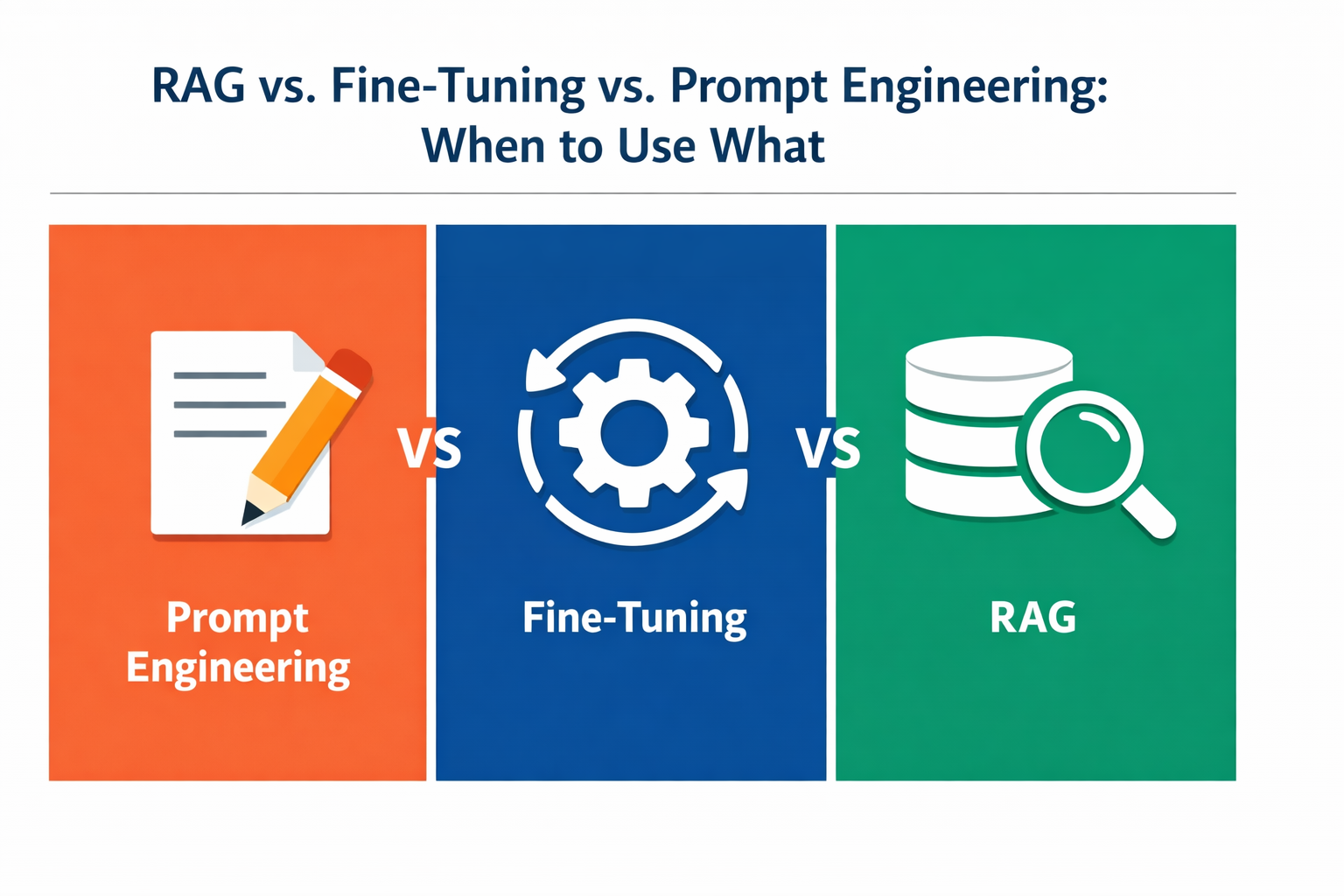
Not every AI problem needs the same solution.
When first exploring ways to make AI “smarter” about specific topics, it’s easy to get confused fast. Fine-tuning? RAG? Better prompts? Everyone seems to have a different answer.
After experimenting with all three approaches, here’s a practical breakdown:
🔹 Prompt Engineering
→ Best for: Quick wins, formatting, tone adjustments
→ What it is: Crafting better instructions for the AI
→ Limitations: The AI still only knows what it was trained on
This is where most people should start. You’d be surprised how far a well-structured prompt can take you. But it won’t help if the AI simply doesn’t have the information you need.
🔹 Fine-Tuning
→ Best for: Teaching the model a specific style or behaviour pattern
→ What it is: Additional training on your own dataset
→ Limitations: Expensive, time-consuming, and the knowledge can still go stale
Fine-tuning makes sense when you need the model to behave differently (like matching a very specific writing voice). But it’s overkill if you just need it to reference some documents.
🔹 RAG (Retrieval-Augmented Generation)
→ Best for: Giving the AI access to current, specific information
→ What it is: Fetching relevant context at query time
→ Limitations: Requires infrastructure (vector DB, embeddings pipeline)
RAG shines when your information changes frequently or when you need responses grounded in specific sources. It’s also way more accessible than fine-tuning for most builders.
The bottom line?
For most automation use cases, especially when building in n8n, RAG is the sweet spot. You get the benefits of domain-specific knowledge without the cost and complexity of fine-tuning.
Start with good prompts. When that’s not enough, add RAG. Save fine-tuning for when you truly need to change the model’s behaviour.