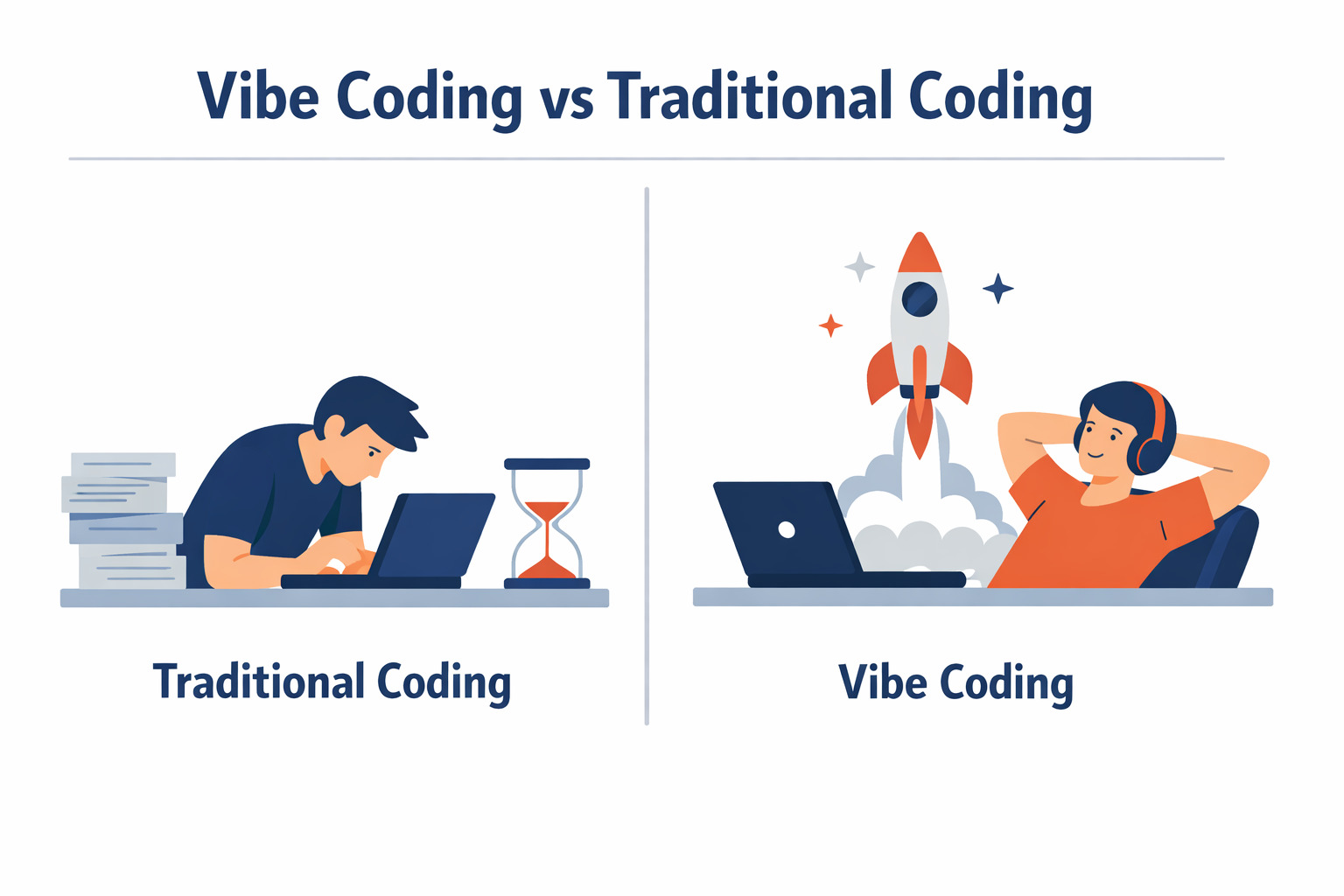
If you’re running a business and wondering whether to stick with traditional coding or switch to vibe coding (that fast, AI-agent-driven way of building software), here’s my straight answer after building dozens of projects both ways: For most businesses right now, vibe coding is the clear winner.
It gets you to market way faster, slashes costs, lets you iterate like crazy, and delivers surprisingly high-quality results with almost no team overhead. The old-school approach of writing every line by hand, manual debugging, and slow iterations just can’t keep up in today’s pace unless you’re dealing with something ultra-complex, security-critical, or massive-scale.
Being first to market beats being perfect every single time. Ship a solid MVP quickly with vibe coding, then improve it based on real users. If you wait for a flawless traditional build, someone else will beat you with a “good enough” version and take the win.
Let me show you why with real examples from projects I’ve done myself.
My favourite tool right now is Google Antigravity. It’s agentic, meaning it doesn’t just generate code it plans, builds, tests, fixes bugs, makes user-flow decisions, and iterates on its own. It feels like having a second pro engineer who works 24/7. The output is clean, bugs are minimal, and the speed is wild.
Quick side-by-side stories
Traditional coding example: When I was CTO at a startup, we rebuilt a full custom SaaS dashboard the classic way (React, Node, etc.). Small team, tight deadline. Weeks went into manual auth setup, bug hunting, design tweaks, deployment headaches. It turned out solid, but the time and burn rate were brutal. Every change slowed us down when the market was flying.
Now with vibe coding:
- A friend’s personal portfolio redesign: Old site needed a refresh. I prompted Antigravity with details plus reference images. It built the whole thing, layout, animations, everything—better than I pictured. The agent then tested it: fixed broken links, CTAs, and mobile issues. Done and deploy-ready in under six hours. Traditional? Days of manual work.
- My own time tracker + checklist tool: Needed it for internal use—user sign-in, dashboard, timers, checklists. Auth was the tricky part (always is). The agent experimented, solved it, and delivered a full working system (front to back, self-tested) in less than 24 hours. I use it daily, shared it with a friend for feedback (all good), zero major fixes needed.
- Custom Chrome extension for lead scraping: For prospecting clients on social media. Prompted my exact needs; it handled the manifest, permissions, logic, UI. Perfect fit for my workflow, built fast, and I tweak it easily.
These are real tools people rely on, not demos. Built at 5–10x the speed.
Pros and cons, no fluff
Vibe coding shines because:
- Speed to live product is insane—hours/days vs. weeks/months.
- Cost drops hard—one person + agent replaces a small team.
- Iteration flies: idea to improved version happens quick, with auto-testing.
- Quality surprises you—clean, low bugs, self-fixing.
Downsides? The output sometimes misses your exact vision (especially creative design). Fix it by attaching images/screenshots to prompts. AI creativity depends on how sharp your inputs are. For super-complex logic, heavy security/compliance, or huge-scale apps with custom everything, traditional still gives more control and easier long-term maintenance. Team collaboration on vibe-built code is evolving but not seamless yet.
Bottom line: Traditional is getting outpaced. AI builds the next AI now—human-only coding will feel outdated fast.
What should your business do?
Jump in today. Try Google Antigravity (free in preview; agent power is top-tier from my tests). Use it for MVPs, internal tools, client deliverables, anything where fast shipping and quick changes win.
Mindset shift: Get it out first, then polish. Waiting for perfection loses the race.
This approach has transformed my freelance work and how I’m building my agency: more time winning clients, less fighting code.
If you want a deeper dive into what vibe coding really means, how it works in practice, and where it can go wrong, check out my earlier post: Vibe Coding Explained: What It Is, When It Works, and Where It Fails. It’s a great companion read for more expert insights.
I’m Oluwaseun, a software developer with a B.Tech. in computer software engineering. I’ve been building since 2018, full pro since 2020, former startup CTO, four years of freelancing experience (personal brands, SaaS tools & E-commerce), and now I’m launching my own agency. Love sharing what actually works in the real world.
Tried vibe coding yourself? What’s your go-to tool or biggest win so far?
Drop a comment, happy to share prompts or tips.
Let’s ship faster. 🚀