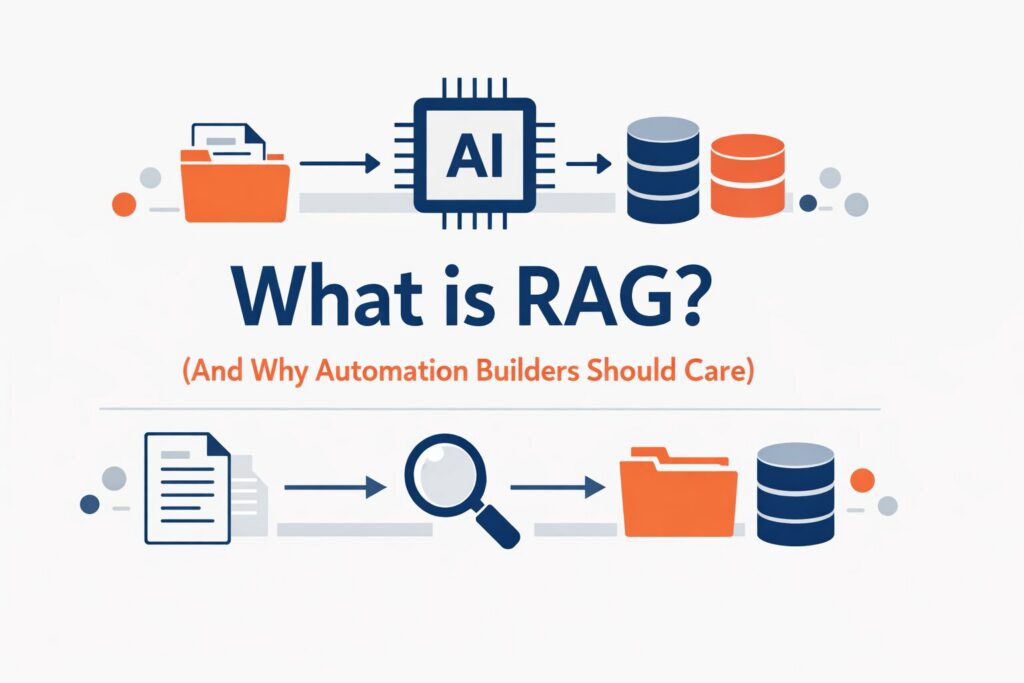
Most AI tools have a memory problem. RAG is the fix.
Ever asked ChatGPT about your company’s internal docs and gotten a confident but completely wrong answer? That’s the wall RAG was built to solve.
RAG stands for Retrieval-Augmented Generation. In plain English: instead of relying only on what an AI model was trained on, you give it access to your own data at the moment it generates a response.
Here’s the simple version:
- You ask a question
- The system searches your documents for relevant context
- That context gets passed to the LLM along with your question
- The AI responds based on your data, not just its training
Why does this matter for automation builders?
If you’re already building workflows in n8n, Make, or Zapier, you’re probably connecting AI to your processes. But without RAG, your AI is working blind. It doesn’t know your SOPs, your product specs, or your customer history.
With RAG, you can build automations that actually know your business.
- Customer support bots that reference your real knowledge base
- Internal assistants that pull from your documentation
- Content workflows that stay on-brand because they have your style guides
RAG is one of those concepts that sounds complex but clicks fast once you see it in action.
Up next: A walkthrough of how to actually build a RAG pipeline in n8n.