Hey everyone, Oluwaseun here a developer with a B.Tech in Computer Science and Software Development. I’ve been in the tech space since around 2019-2020, freelancing, running my own agency, building complete software projects from the ground up, and creating design systems for various companies.
I’ve lived through the traditional dev world: detailed planning, line-by-line coding, weeks or months of testing, and hefty budgets just to launch something. But over the last couple of years, AI-driven approaches have flipped the script, and what’s now widely called “vibe coding” stands out as one of the biggest shifts I’ve seen.
So, what is vibe coding?
The term was coined by AI researcher Andrej Karpathy in early 2025, when he described it as a new style of coding where you “fully give in to the vibes, embrace exponentials, and forget that the code even exists.” Instead of meticulously writing and reviewing every line of code.
You describe your concept in natural language, discussing the overall feel, features, and goals, and powerful AI tools generate, refine, and even debug the application for you. It’s prompt-heavy, conversational, and focused on intent over syntax. You iterate by saying “make it more like this” or “fix that part”, and you accept changes quickly to keep momentum going. It’s perfect for rapid prototyping, weekend experiments, or getting ideas into the real world fast- without getting bogged down in the weeds.
From my hands-on experience, Vibe coding is a complete game-changer because it democratises software creation. People with strong ideas but no deep coding background can now build real solutions in hours or days, rather than months.
One of the most eye-opening examples for me was a non-tech friend who faced a tough language barrier after moving to a new city local dialects weren’t handled well by existing translation apps, making everyday interactions (like coordinating with movers) frustrating. With zero coding knowledge, she sat down for about two hours (while eating lunch!) and, through detailed prompting, built a custom translation app tailored to those local languages. It actually worked and started helping people communicate right away. That’s the magic: turning real-world problems into functional tools lightning-fast, no CS degree required.
For businesses, whether startups, small agencies, established companies testing new features, or entrepreneurs spotting market gaps, this opens up massive opportunities. You can prototype ideas quickly, validate them with users or clients, gather feedback, and iterate before investing in full-scale development.
At my agency, we use it to shortcut the process: once we have a clear client vision, we vibe-code a working prototype early on, show it to them for input, refine it, and only then move into building the robust, structured framework. This slashes time-to-market, cuts costs, and lets us experiment more freely without big risks.
Vibe Coding Tools I’ve Found Most Effective
I’ve tested a range of these, and the ones delivering the best results for me right now include:
- Lovable: Excellent for prompt-heavy, full-stack building where clarity on your vision is key.
- Base44: Super fast for turning business intent into functional apps, often with minimal fixes needed.
- CloudCode: strong for agentic, workflow-driven setups.
- Antigravity: Great for more complex, directed builds
Plus classics like ClaudeCode and Cursor: still go-tos for detailed prompting and iteration.
CloudCode and Antigravity (agentic IDEs) are great for more complex, directed builds. check this out. If you want to understand the difference between regular RAG and Agentic RAG and when to use each,
How I Actually Use Vibe Coding Tools (My Practical Workflow)
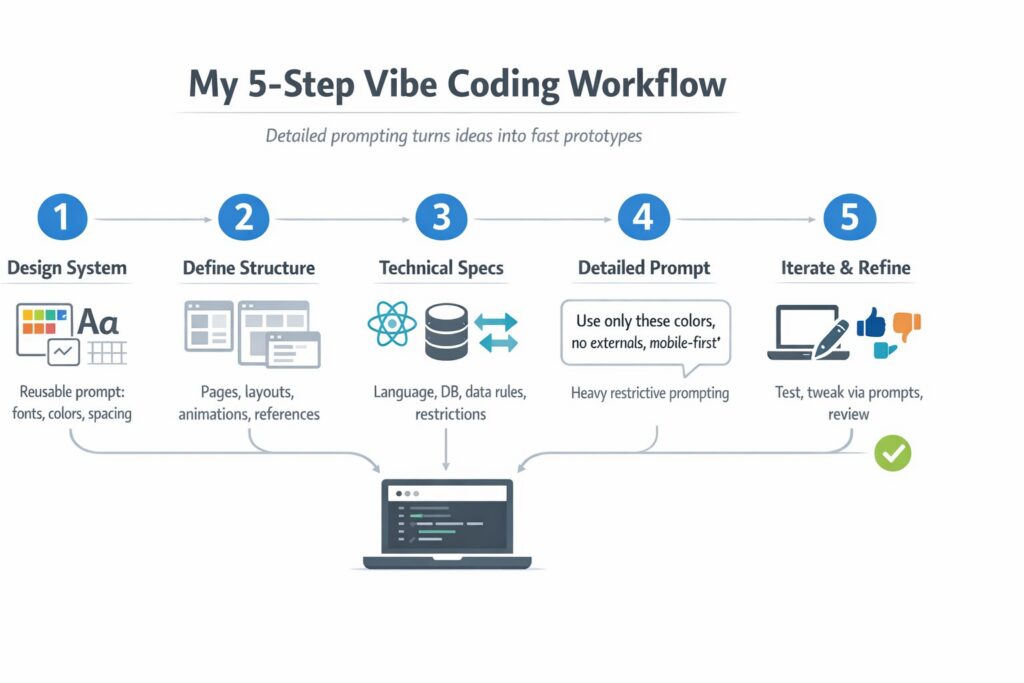
Even though it’s “vibe” coding, success comes from being intentional and detailed in prompts, not just winging it. Here’s how I approach it:
- Nail the design system first: I create a detailed, reusable prompt covering fonts, typography, spacing, colours, overall style guide, and branding rules. This ensures consistency across outputs.
- Define the full structure upfront: Specify the number of pages/screens, the layout for each (e.g., hero section, features, and forms), content types, animations, and even reference sites I like for inspiration (“Navbar similar to [example.com], but cleaner”).
- Get technical where it counts: State the preferred language/framework (e.g., React + Node.js), database setup, data handling rules, output formats, and explicit restrictions (e.g., “Avoid external dependencies unless necessary” and “Prioritise security best practices”).
- Prompt restrictively and iteratively: Be ultra-clear: “Use only these colours,” “No inline styles,” “Make it fully responsive.” Follow up with tweaks based on runs/tests.
- Deploy and refine early: Build the MVP version ASAP, test it, get feedback, and prompt changes. Editing is easier when the foundation matches your specs.
I dive in as soon as the core idea is sosolid;t’s ideal for early-stage validation, MVPs, or quick feature tests. You get something tangible to market or show stakeholders way faster than traditional cycles.
(see my deep dive on when to use prompt engineering vs. RAG vs. fine-tuning for more advanced strategy)
The Balanced Take: It’s Powerful, But Not Without Limits
Vibe coding isn’t overhyped. It’s the real deal and here to stay. In the long run, we’ll move toward “speaking” to machines more than manually coding everything. It creates more opportunities for people to enter tech, levels the playing field, and shifts focus to higher-level skills like prompting, architectural oversight, and problem-solving.
That said, those with a solid tech foundation (understanding data structures, debugging, security) still have a clear edge, they guide prompts better and catch/fix issues when AI hallucinates or overlooks edge cases. For businesses, the biggest wins go to startups and small teams testing ideas, non-technical founders/entrepreneurs solving niche problems, and anyone needing speed over perfection.
Key caveats I always keep in mind:
- Security and quality risks: AI-generated code can introduce vulnerabilities, particularly in data handling and authentication. Never blindly deploy to production for anything sensitive; always audit, test thoroughly, and layer in manual reviews.
- Best as an accelerator, not a full replacement: Phenomenal for prototypes, idea validation, and non-critical features. For mission-critical systems, scalability needs, or complex logic, blend it with traditional dev practices
. - Adapt or get left behind: Devs and agencies must learn to implement these tools effectively. The future favors those who orchestrate AI well, not just those who code manually.
Practical Advice for Businesses Getting Started
If you’re a business owner or leader eyeing this (no coding background needed):
- Pick an accessible tool first; try Lovable or Base44 for their beginner-friendly, full-app generation.
- Clarify your idea: What core problem does it solve? Who uses it? Must-have features?
- Write detailed prompts using the structure tips above; clarity wins.
- Start small: build one key feature or page, run it, gather feedback, and iterate.
- Treat prompting as a new skill; practice makes outputs sharper.
- For anything involving real user data, payments, or compliance, involve a dev for security review before going live.
Vibe coding isn’t about replacing developers; it’s about amplifying creativity, speeding up innovation, and letting more people build what matters. In my work, it’s helped us deliver value faster, test bolder ideas, and turn concepts into reality quicker than ever. If you’ve got a business problem that software could fix, the tools are there, the barriers are low, what’s stopping you from vibing it into existence?
Drop a comment if you’ve tried vibe coding, have a project in mind, or want tips on prompting. Let’s talk building!